.png)


.png)



AI-Powered Key Takeaways


Table of Contents

Traditional automation testing has long helped QA teams reduce repetitive manual effort and improve release consistency. Frameworks like Selenium, Playwright, Cypress, and Appium made automated testing a core part of modern software delivery.
However, modern applications change rapidly. Frequent UI updates, shorter release cycles, and growing cross-platform complexity often make test scripts difficult to maintain.
AI-powered testing addresses some of these challenges by improving test creation, maintenance, execution, and failure analysis.
Not only this, features like self-healing tests and risk-based test prioritization are changing how teams manage automation at scale.
This article explores the key differences between AI-powered testing and traditional automation testing, including where each approach fits best.
What Is Traditional Automation Testing?
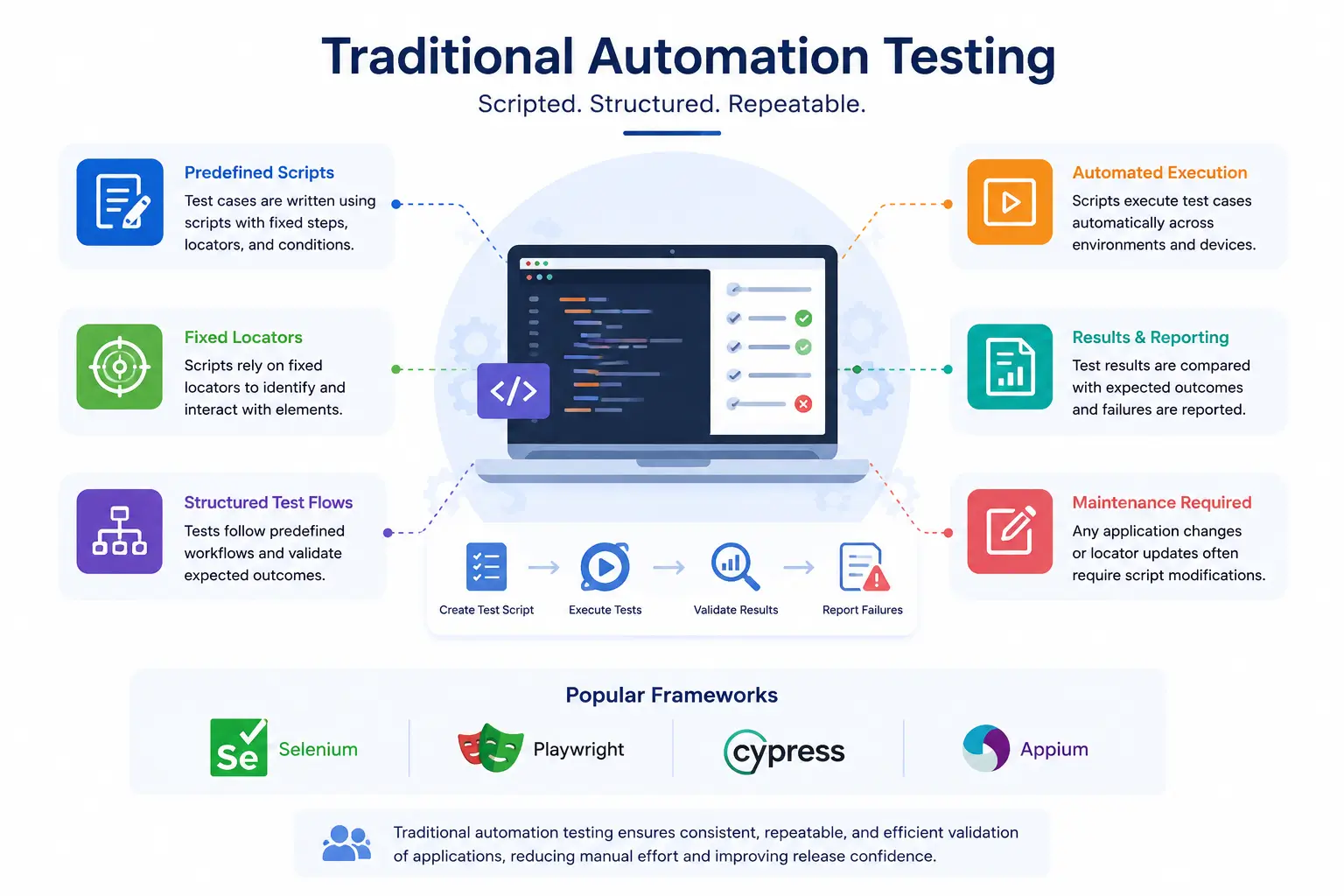
Traditional automation testing involves using predefined scripts and testing frameworks to automatically validate application functionality.
Instead of manually repeating the same test cases during every release cycle, teams create scripts that execute specific workflows, compare expected outcomes, and report failures.
Test scripts rely on fixed locators, predefined conditions, and structured test flows to interact with an application. If the application behaves as expected, the test passes. If an element changes or a workflow breaks, the script often requires manual updates.
Popular frameworks such as Selenium, Playwright, Cypress, and Appium are widely used to automate web, mobile, and cross-browser testing workflows. These frameworks help teams execute regression suites consistently and reduce the time required for repetitive validation.
What Is AI-Powered Testing?
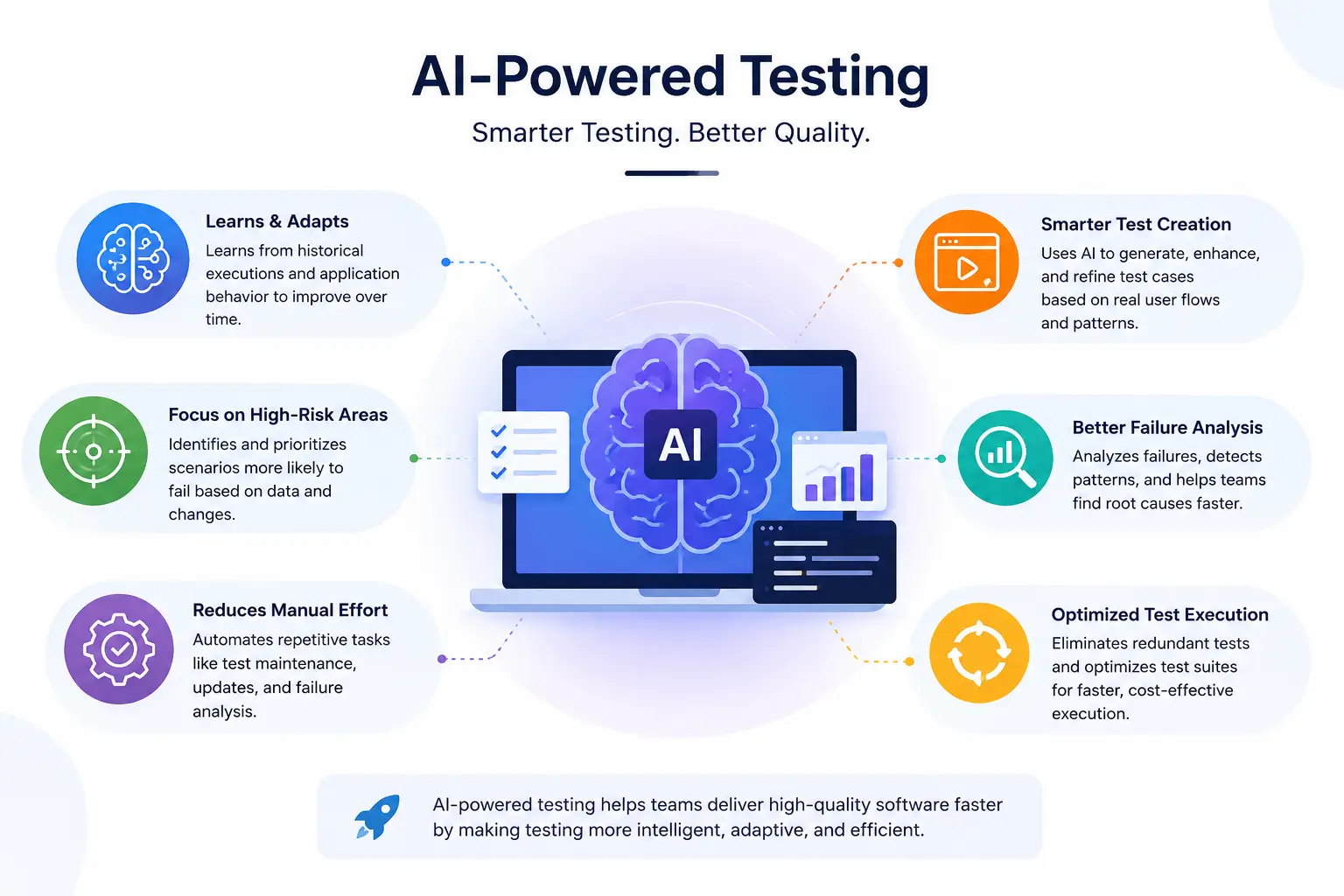
AI-powered testing uses artificial intelligence and machine learning techniques to assist with test generation, execution, maintenance, and analysis.
Unlike traditional automation, which depends heavily on predefined scripts and fixed rules, AI-driven testing systems can learn from historical executions, application behavior, and usage patterns to make testing more adaptive.
AI-powered testing is not limited to test execution alone. It helps teams prioritize higher-risk areas and reduce unnecessary testing by leveraging historical execution patterns. Instead of treating every test case equally, AI models can prioritize scenarios that are more likely to fail based on previous execution data and application changes.
This approach is becoming increasingly useful in environments with rapid releases, frequent UI updates, and large regression suites where maintaining traditional automation scripts can become time-consuming.
AI-Powered Testing vs Traditional Automation Testing: Core Differences
The table below highlights the high-level differences before we examine each area in detail.
The differences become more visible in areas such as script creation, maintenance, execution strategy, and failure analysis.
Test Script Creation
Traditional Automation: Traditional automation testing depends heavily on manually written scripts. QA teams define test steps, element locators in advance. This gives teams strong control over testing behavior, but it also increases scripting effort, especially for large applications with complex workflows.
AI-Powered Testing: AI-powered testing reduces some of this dependency by assisting with test generation and workflow identification. Some AI-driven platforms can analyze user behavior, application flows, or previous executions to recommend or generate test scenarios automatically. This helps teams accelerate test creation, particularly in applications with rapidly changing interfaces.
Test Maintenance
Traditional automation: Even small UI changes can break locators and cause test failures. QA teams often spend considerable time updating scripts after every release.
AI-powered testing: AI testing attempts to reduce this maintenance overhead through self-healing capabilities and adaptive element recognition. Instead of failing immediately when an element changes, the system can analyze DOM attributes to identify likely matches and continue execution with minimal manual intervention.
Test Coverage
Traditional automation: In traditional automation, typically focuses on predefined test scenarios created by QA teams. Coverage depends largely on available time, resources, and scripting effort. As applications grow, identifying every possible edge case manually becomes difficult.
AI-powered testing: It can improve coverage by identifying additional execution paths, detecting usage patterns, and highlighting high-risk areas that may require more testing attention. This helps teams uncover scenarios that may not have been included in manually created test suites.
Execution and Prioritization
Traditional automation: Conventional automation frameworks generally execute test suites in fixed sequences. Many teams run full regression suites repeatedly, even when only specific application areas have changed.
AI-powered testing: AI testing introduces intelligent prioritization. Instead of executing every test equally, AI models can identify which test cases are most relevant based on code changes, historical failures, and application risk areas. This helps reduce unnecessary test execution and improves feedback cycles.
Failure Analysis
Traditional Automation: In traditional automation, failed tests often require manual investigation to determine whether the issue comes from the application, environment instability, or broken scripts. Large test suites can make this process time-consuming.
AI-powered testing: AI-powered testing can help teams investigate failed tests by analyzing execution logs, screenshots, and historical test results to identify likely causes of failure.
Also read - A Detailed Guide to Test Coverage
Advantages of Traditional Automation Testing
Traditional automation testing continues to play a critical role in many QA environments, especially where applications are stable and workflows are well-defined. Its structured and predictable nature makes it reliable for repetitive validation tasks.
Some of the key advantages include:
- Greater control over test execution: QA teams define every test step, assertion, and execution condition explicitly, making test behavior predictable and easier to debug.
- Strong support for regression testing: Automated regression suites can repeatedly validate core functionality across releases with consistent execution.
- Flexible framework ecosystem: Tools like Selenium, Playwright, and Appium support extensive customization, integrations, and CI/CD workflows.
- Better fit for compliance-driven testing: Industries with strict validation requirements often prefer deterministic and traceable test execution over adaptive decision-making.
- No dependency on historical training data: Traditional automation frameworks operate based on predefined logic and do not require behavioral learning models to function effectively.
Advantages of AI-Powered Testing
AI-powered testing helps teams manage some of the biggest challenges associated with maintaining large and rapidly evolving test environments. Instead of relying entirely on static scripts and fixed execution flows, AI-driven systems introduce adaptability into different stages of the testing lifecycle.
Some of the key advantages include:
- Reduced test maintenance effort: Self-healing capabilities can automatically adjust to certain UI or locator changes, reducing the number of broken scripts after releases.
- Improved testing efficiency: Intelligent test prioritization helps teams focus execution on high-risk areas instead of repeatedly running unnecessary test cases.
- Better support for large regression suites: AI-driven analysis can prioritize test execution using historical results, failure patterns, and application changes, reducing the time required for regression testing.
- Smarter failure analysis: Pattern recognition helps identify recurring defects, group similar failures, and reduce false positives caused by unstable scripts.
- Useful for rapid release environments: Agile and DevOps teams with frequent deployments can benefit from faster feedback and reduced maintenance overhead.
Can AI-Powered Testing and Traditional Automation Work Together?
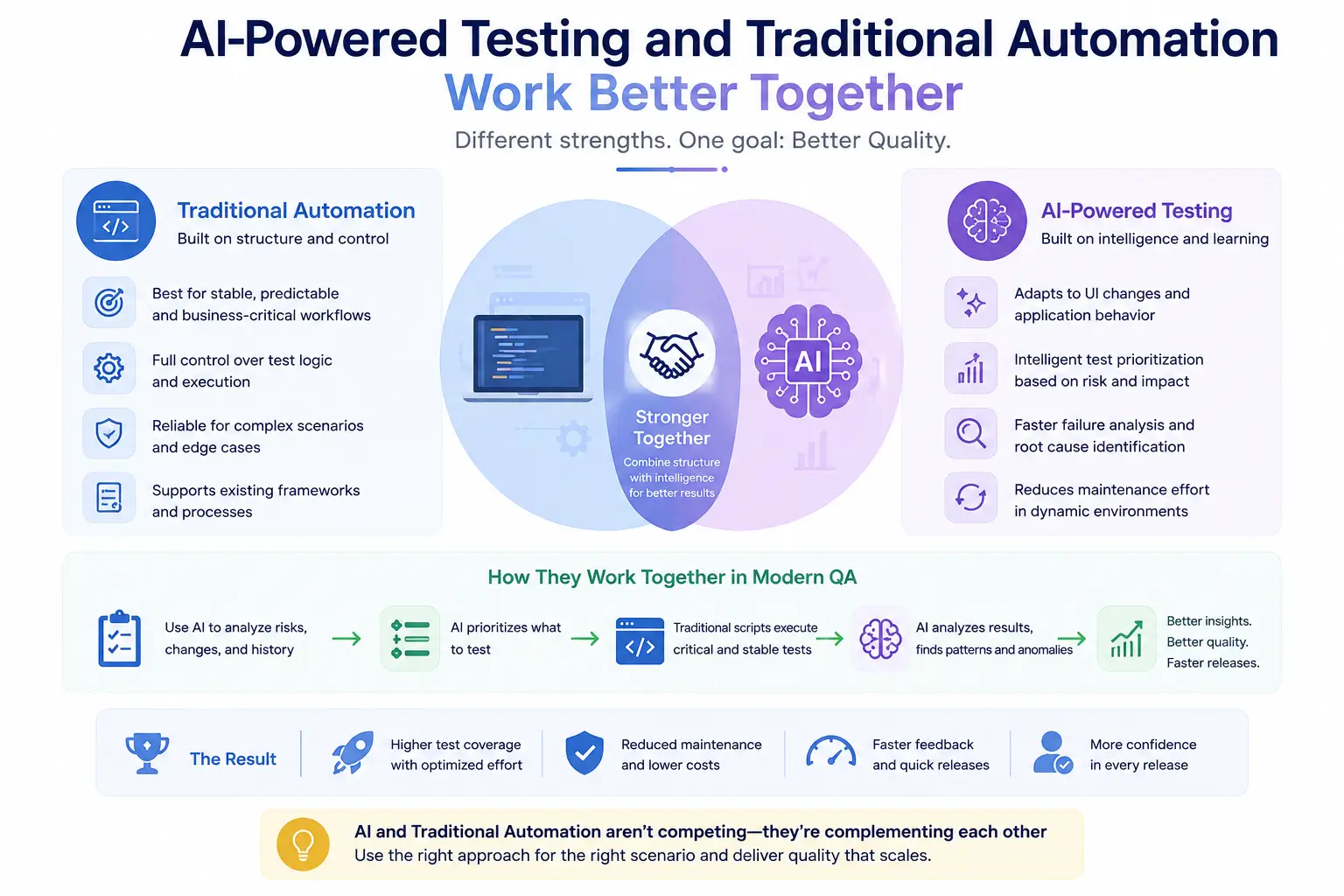
AI-powered testing is not a complete replacement for traditional automation. Most organizations already have significant investments in frameworks such as Selenium, Playwright, Cypress, or Appium.
In many QA environments, traditional automation continues to execute core business workflows, regression tests, and compliance-critical scenarios where teams require precise control over test logic and expected outcomes.
AI-powered capabilities are often layered on top of these existing frameworks to address challenges that traditional automation struggles with.
For example, AI can assist with test generation, reduce script maintenance through self-healing mechanisms, prioritize test execution based on recent application changes, and help teams investigate recurring test failures more efficiently.
This combination allows teams to retain the reliability and predictability of scripted automation while using AI to reduce maintenance overhead and improve testing efficiency.
Rather than replacing traditional automation, AI is increasingly being used to extend and enhance existing testing workflows.
When Does AI-Powered Testing Make More Sense?
AI-powered testing becomes more valuable in environments where applications change frequently and maintaining large automation suites becomes difficult. Teams dealing with rapid releases, dynamic UI updates, and growing cross-platform complexity often struggle to keep traditional scripts stable over time.
It is particularly useful for organizations running large regression suites, Agile and DevOps pipelines, and applications that require testing across multiple devices, browsers, and user conditions. AI-driven capabilities like self-healing tests, intelligent prioritization, and automated failure analysis help reduce maintenance effort and improve execution efficiency in these scenarios.
For teams spending more time fixing automation scripts than expanding test coverage, AI-powered testing can help improve scalability and reduce operational overhead.
Wrapping Up
As applications become more complex and release cycles continue to shrink, testing strategies also need to evolve. Traditional automation provides structure and reliability, while AI-powered testing helps teams handle changing interfaces, large test suites, and growing execution complexity more efficiently.
The right approach depends on the application, release cadence, and testing goals. In many cases, teams achieve better results by combining scripted automation with AI-driven capabilities instead of treating them as separate or competing solutions.
FAQs
Q1. Is AI-powered testing replacing traditional automation testing?
Ans: No. Traditional automation testing is still widely used for stable and predictable workflows. AI-powered testing is mainly helping teams reduce maintenance effort, improve execution efficiency, and manage large-scale testing environments more effectively.
Q2. What is the biggest advantage of AI-powered testing?
Ans: One of the biggest advantages is reduced test maintenance. Features like self-healing tests, intelligent prioritization, and automated failure analysis help teams manage changing applications with less manual intervention.
Q3. When should teams consider AI-powered testing?
Ans: AI-powered testing makes more sense for applications with frequent UI updates, rapid release cycles, large regression suites, and multi-platform testing requirements where maintaining traditional automation scripts becomes difficult.







-1280X720-Final-2.jpg)