.png)


.png)


AI-Powered Key Takeaways


Table of Contents

LambdaTest Isn’t Enough: Explore Top LambdaTest (TestMu) Alternatives
LambdaTest, now TestMu AI, is a cloud-based testing platform for running automated tests across browsers, operating systems, and real devices. Its broad environment coverage makes it useful for teams that need scalable test execution without maintaining the underlying infrastructure.
However, teams need more than test execution to understand what’s affecting application quality. They need deeper visibility into application performance and network behavior on real devices, along with greater control over test creation and infrastructure. When existing testing setups fall short, teams need to evaluate what their current platform is missing and whether a different approach can address those gaps.
This guide covers six LambdaTest alternatives. We’ll compare their capabilities, strengths, limitations, and use cases.
Where LambdaTest falls short
LambdaTest covers common browser and mobile testing requirements, but some teams need testing capabilities that go beyond standard device matrices and simulated network conditions.
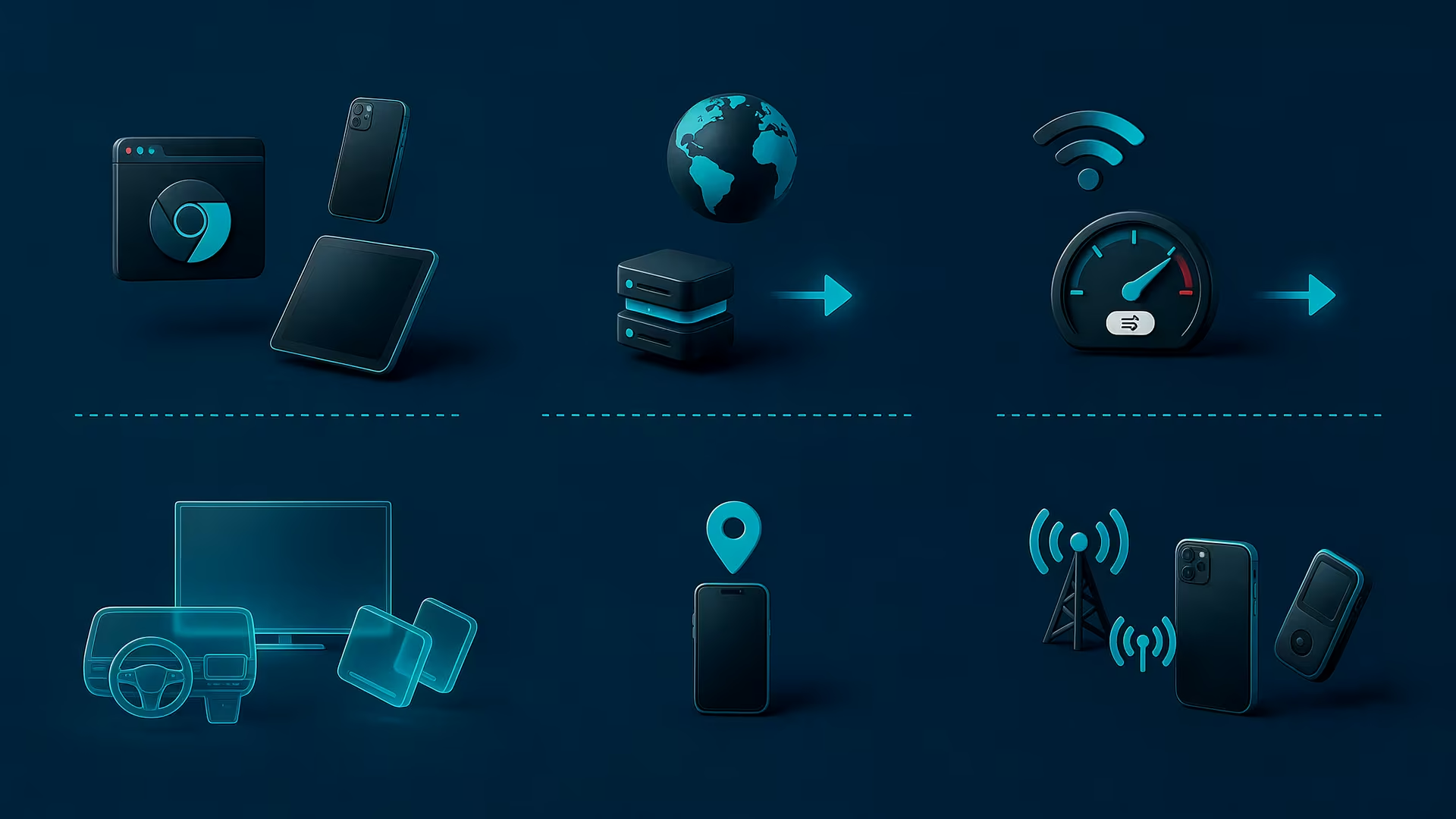
1. Device coverage does not extend to specialized hardware
Imagine your team is developing a streaming app for connected TVs. The app works as expected on mobile devices and browsers, but the TV experience introduces different interactions, hardware constraints, and playback behavior. Passing tests on phones and browsers does not confirm that the app works as expected on a connected TV.
Testing on the target hardware becomes necessary to validate the experience on the devices your customers use. LambdaTest’s browser, phone, and tablet coverage may not provide access to the specialized hardware your product requires. Teams may therefore need to source and maintain separate devices or connect their own hardware labs to test these environments.
2. Changing the test location does not change where the device is
LambdaTest supports geolocation testing by routing a session through a VPN or proxy, allowing the session to appear as though it originates from another location. However, the physical device remains in the location where the underlying infrastructure is hosted.
That distinction matters when application behavior depends on the physical location of the device or the network available at that location. For example, teams testing region-specific behavior may need to run the application on a device physically located in the target market rather than simply route its traffic through a different IP location.
3. Network simulation does not replace local carrier testing
LambdaTest provides network throttling to simulate conditions such as reduced bandwidth and increased latency. This is useful for evaluating how an application responds to controlled network constraints, but it does not replicate every characteristic of a local mobile carrier network.
Carrier-specific testing can involve factors such as network availability, handovers, roaming, signal strength, and carrier behavior. Validating these scenarios requires a physical device connected to the relevant carrier network in the target region. When testing relies on simulated network profiles instead, teams may need separate infrastructure to validate these carrier-dependent scenarios.
Also read - Performance Testing vs Load Testing: Key Differences Explained
Top LambdaTest alternatives at a glance
1. HeadSpin
HeadSpin is a real device cloud built to provide deep performance analysis across applications, devices, and networks. It helps teams move beyond functional test results to understand application behavior, identify performance issues, and investigate what affects the user experience.
HeadSpin provides access to physical devices across 50+ global locations, including smartphones, tablets, connected TVs, automotive systems, and media players. It automatically captures 130+ app, device, and network KPIs, giving teams detailed performance insights from the same test session.
Strengths:
- Real device cloud spanning 50+ global locations, including device categories most competitors don't offer, such as automotive and IoT
- Over 130 performance KPIs captured automatically on every run, not just a pass or fail result
- Network condition simulation, so teams can see how an app behaves on 3G, 4G, 5G, congested Wi-Fi, or a specific carrier before real users do
- Supports existing Appium and Selenium scripts, so switching doesn't mean rewriting a suite
- Bring-your-own-device support for testing on hardware outside HeadSpin's own inventory
How HeadSpin compares to LambdaTest: Both run tests across real environments, but LambdaTest's core value is breadth, thousands of browser and OS combinations for teams that already have scripts. HeadSpin emphasizes more data about what actually happened during a session and why. Teams moving off LambdaTest specifically because failures don't explain themselves tend to land here first.
2. Playwright
Playwright is an open-source browser automation framework from Microsoft, supporting Chromium, Firefox, and WebKit from a single API. It doesn't replace what LambdaTest does exactly. LambdaTest is a place to run tests; Playwright is how a team writes and drives them. But many teams researching lambdatest automation alternatives are really asking whether they need a paid execution cloud at all if their browser matrix is small enough to run on their own CI infrastructure.
Strengths:
- Free and open source, with no per-session or parallel-execution charges
- Modern API with built-in network interception, auto-waiting, and parallel execution
- Fast, actively maintained, with strong TypeScript and JavaScript support
3. Cypress
Cypress is an open-source JavaScript testing framework that runs tests directly inside the browser alongside the application, rather than driving the browser from outside the way Selenium and Playwright do. That architecture gives it automatic waiting and time-travel debugging, where every step of a test can be replayed and inspected after the fact.
Strengths:
- Free and open source core framework under the MIT license, with no per-session charges
- Time-travel debugging shows exactly what the DOM looked like at each step of a failing test
- Fast feedback loop for teams working on the same web app the tests are written against
4. Selenium Grid
Selenium Grid is the open-source execution layer behind the original WebDriver standard, letting teams distribute tests across machines and browsers they control. It's the most direct open-source counterpart to what LambdaTest actually charges for: parallel execution across environments.
Strengths:
- Completely free, with no session-based pricing
- Supports every language binding Selenium supports, including Java, Python, C#, JavaScript, and Ruby
- Full control over the underlying infrastructure and browser versions
Also read - Selenium Wait Commands: Implicit, Explicit & Fluent Waits
5. WebdriverIO
WebdriverIO is an open-source browser and mobile automation framework built on the WebDriver and Chrome DevTools protocols, maintained under the OpenJS Foundation. It's often the pick for teams that like Selenium's WebDriver foundation but want a more modern JavaScript-first API, with native Appium integration for mobile testing built in.
Strengths:
- Free and open source, with no vendor lock-in
- Native Appium integration, so the same framework can drive both browsers and real mobile devices
- Large plugin ecosystem for reporting, visual testing, and CI integration
6. Appium
Best for: Teams automating native or hybrid mobile apps on iOS and Android.
Appium is the open-source standard for mobile app automation, using the WebDriver protocol to drive real apps the same way Selenium drives browsers. LambdaTest supports Appium scripts as an execution layer; Appium itself is how those scripts get written in the first place.
Strengths:
- Free and open source, with a large community and wide framework support
- Works across native, hybrid, and mobile web apps on both iOS and Android
- Not tied to any single cloud vendor; scripts run wherever they're pointed
Also read - Appium Testing: The Complete Guide to Mobile Automation
How to choose the right LambdaTest alternative
The right alternative depends on the testing capabilities, infrastructure, and level of control your team needs.
1. Real device performance
If your team needs more than functional pass/fail results, look for a platform that combines real device testing with application, device, and network performance data. HeadSpin provides this combination, including performance analytics across real devices and networks.
2. Debugging needs
If your priority is fast feedback and debugging for web applications, Cypress provides built-in time-travel debugging and runs tests directly in the browser.
3. Browser coverage
If your testing strategy requires automation across Chromium, Firefox, and WebKit, Playwright provides a single API for these browser engines.
4. Infrastructure control
If your team wants to self-host test execution and already has a Selenium-based suite, Selenium Grid or WebdriverIO can provide greater control over the underlying infrastructure.
5. Mobile automation
If your primary requirement is native, hybrid, or mobile web app automation, Appium provides an open-source framework for iOS and Android. It can be connected to a real device source such as HeadSpin or an internal device lab.
Conclusion
LambdaTest, now TestMu AI, is a solid execution layer for teams that already have test scripts and need broad browser coverage. But "alternative" means different things depending on what's actually missing: more device and performance depth, or a cheaper, self-hosted setup with full control over the infrastructure.
If performance and network visibility on real devices is the gap, HeadSpin is the most direct upgrade. If it's cost and control, the open source route removes the subscription entirely: Playwright or Cypress for browser testing, Selenium Grid or WebdriverIO if the team already thinks in WebDriver, and Appium the moment mobile apps enter the picture.
FAQs
Q1. What is the best LambdaTest alternative overall?
Ans: HeadSpin is the strongest overall pick for teams that need real device testing combined with performance and network diagnostics. For teams that would rather self-host and skip the subscription entirely, Playwright is the most widely adopted open source alternative.
Q2. What are the best LambdaTest automation alternatives for developers?
Ans: Playwright, Cypress, Selenium Grid, and WebdriverIO are the most common open-source picks. All four let a developer-led team write and run tests without per-session cloud pricing, at the cost of owning the infrastructure themselves.
Q3. What is the best LambdaTest real device testing alternative?
Ans: HeadSpin is the only platform on this list built as a managed real device cloud, running tests on physical devices across more than 90 locations with performance and network analytics included. None of the open source frameworks here provide real devices on their own; Appium is the standard way to drive real hardware once a team has a device source of its own.
Q4. Do I need a real device cloud if I already use Playwright or Selenium?
Ans: It depends on what's being tested. Playwright and Selenium automate browsers, not physical phones. If mobile testing on real hardware matters, either framework typically gets paired with a device source like HeadSpin or Appium plus owned devices.
Q5. Are there free LambdaTest alternatives?
Ans: Playwright, Cypress, Selenium Grid, WebdriverIO, and Appium are all free and open source. Infrastructure to run them on still has to come from somewhere, so "free" means no subscription, not zero cost at scale.




-1280X720-Final-2.jpg)