.png)


.png)



AI-Powered Key Takeaways


Table of Contents

Your checkout flow needs aggressive regression checks before every release. Your payment APIs need continuous validation. Your streaming player needs performance testing under congested mobile networks. The same generic test suite serves none of them well.
Different systems carry different quality risks, and that single truth explains why mature engineering organizations don't just write more tests. They build deliberate software testing strategies that decide what to test, why, and how.
Yet as delivery accelerates, software grows more entangled. A single mobile app might depend on dozens of microservices, third-party SDKs, payment gateways, content delivery networks, and edge nodes spread across continents. Each dependency is another place where quality can quietly fracture.
That is where testing strategies become vital.
This article is a detailed guide on what software testing strategies are, their importance, different approaches, and their future moving forward.
What are Software Testing Strategies?
A software testing strategy is a structured plan that defines how testing will be performed throughout the software development lifecycle. It helps teams decide what to test, when to test it, which testing methods to use, and how to allocate testing resources.
A useful way to picture it: a strategy is to test what an urban transit policy is on a single bus route. The route moves passengers from one stop to the next. The policy decides which routes exist, how often they run, and which neighborhoods get served first. Testing strategies in software engineering operate at that policy level. They shape the decision-making system in which hundreds of individual test cases live.
Takeaway: A testing strategy is a blueprint for quality decisions, not a list of tests. It exists to manage release risk in the service of business outcomes.
Why Software Testing Strategies Matter
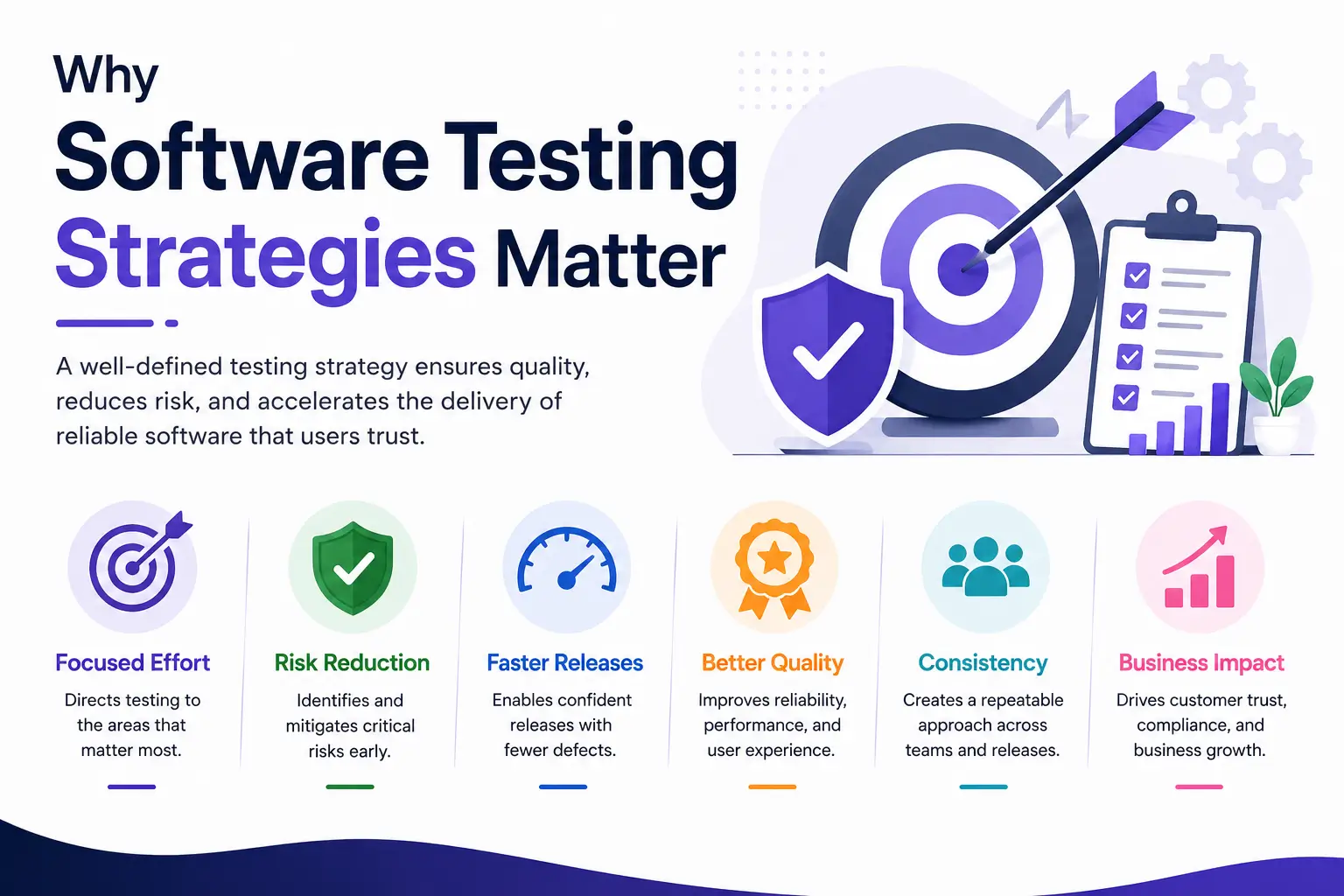
A software testing strategy does more than help teams find defects. Without a testing strategy, teams often spend too much time testing low-risk areas while critical business functions remain exposed.
1. Reduces Business Risk
Not every defect carries the same impact. A broken profile page and a failed payment transaction have very different consequences. A testing strategy helps teams identify high-risk areas and allocate testing effort accordingly.
For example, a telecom provider may prioritize billing validation and service activation workflows because failures in these systems can lead to revenue loss, customer complaints, and regulatory scrutiny. Focusing testing on the most critical business processes reduces the likelihood of costly production incidents.
2. Improves Product Quality
Quality issues can arise unexpectedly. Running more tests does not necessarily produce better software.
A testing strategy defines the right mix of functional, regression, performance, security, and usability testing needed for a product. This balanced approach helps teams uncover defects across multiple quality dimensions and deliver a more stable user experience.
3. Supports Faster Releases
As release cycles shorten, manual validation alone becomes a bottleneck. Teams need confidence that critical functionality is continuously verified throughout development.
A testing strategy identifies which tests should be automated, which require manual review, and where testing should occur within the delivery pipeline. This allows teams to release more frequently without sacrificing quality.
4. Improves Customer Experience
Users judge software based on reliability, responsiveness, and consistency. Even small issues such as slow page loads, buffering video streams, failed transactions, or intermittent application crashes can affect customer satisfaction.
A testing strategy ensures that testing reflects real-world conditions, including different devices, browsers, operating systems, and network environments. This helps teams identify user-facing issues before they reach production.
5. Reduces Long-Term Costs
The cost of fixing a defect rises dramatically the later it is discovered. A bug caught during development might take minutes or hours to resolve, while the same issue found in production can require emergency fixes, customer support intervention, downtime, and extensive investigation.
That’s why an effective testing strategy emphasizes early detection. Identifying defects before they reach customers and concentrating testing efforts on the areas that matter most helps teams reduce rework, avoid costly production incidents, and keep long-term maintenance and support costs under control.
6. Increases Release Confidence
Software releases should be based on evidence rather than assumptions. A testing strategy establishes clear quality criteria and validation processes that help teams assess release readiness.
When testing activities are aligned with business risk and quality objectives, stakeholders gain greater confidence in deployment decisions and reduce reliance on last-minute manual verification.
7. Strengthens System Resilience
Distributed systems must continue operating even when individual components fail. Network degradation, service outages, API failures, and infrastructure disruptions are inevitable in modern environments.
A mature testing strategy includes resilience testing, fault injection, and failure scenario validation to verify that applications can handle disruptions gracefully and maintain acceptable service levels.
8. Supports Regulatory and Compliance Requirements
Industries such as banking, financial services, healthcare, and telecommunications operate under strict regulatory requirements. Organizations must demonstrate that systems protect sensitive data, maintain integrity, and meet compliance obligations.
A testing strategy that incorporates security validation, audit requirements, and compliance checks throughout the development lifecycle makes regulatory reviews more manageable and reduces the risk of violations.
Also read - 20+ Types of Software Testing Every QA Must Know
Core Components of a Software Testing Strategy
A complete strategy is built from parts that depend on each other. Each one answers a specific question, and each gets weaker standing alone.
- Testing objectives define what success looks like in measurable terms. This could mean reducing critical production defects by a specific percentage, meeting response-time targets, or satisfying compliance requirements. Without clear objectives, teams often test out of habit and struggle to demonstrate the value of their efforts.
- Scope and Coverage define the boundaries of testing. They determine which features, platforms, devices, integrations, and scenarios will be tested, and just as importantly, which ones will not. Clear boundaries help teams focus their efforts and avoid spending time on areas outside the testing objectives.
A retail app might pour effort into the purchase funnel and payment integrations while easing off rarely touched admin screens. Let risk and real usage data steer those calls, not whatever happens to be easiest to test.
- Test levels describe where validation happens, and a healthy strategy invests across all of them:
- Unit testing checks individual functions in isolation,fast, cheap, usually owned by developers.
- Integration testing verifies components work together, catching interface mismatches and broken data flows between services and APIs.
- System testing validates the full, assembled application against its requirements.
- Acceptance testing confirms the software meets user and business needs before release.
- Test types define the quality attributes that need validation. A testing strategy typically includes functional, regression, performance, security, usability, and compatibility testing, with the mix determined by the application's risk profile and business requirements.
For example, regression testing is critical in rapid release environments where even minor code changes can introduce unintended issues. Security testing focuses on identifying vulnerabilities, authentication weaknesses, misconfigurations, and exposed interfaces before they become production risks.
- Test environment strategy is about fidelity. Testing a media app only on the latest flagship device over high-speed Wi-Fi hides the experience many users actually have. The strategy should define how devices, hardware, databases, and network configurations are set up and maintained, including degraded and real-world conditions.
- Test data management keeps results honest. Bad data produces false passes and missed defects. Decide how you'll generate it, how you'll mask PII and credentials, and how you'll version it. In regulated industries, synthetic or masked data lets you exercise edge cases without ever exposing a real customer record.
- Automation strategy decides what to automate, which frameworks to standardize on, and how to keep suites alive over time. The aim is to automate the repetitive, stable, high-value checks so people stay free for the work that needs judgment.
- Defect management sets how issues get logged, triaged, fixed, and verified, with clear severity levels and ownership so critical bugs don't get buried under noise.
- Reporting and metrics close the loop. Detailed reports with logs and screenshots help you tell a real defect apart from a flaky test. Track defect density, escape rate, coverage, and mean time to resolution so you can actually measure progress.
- Entry and exit criteria are the guardrails. Entry might require stable environments and ready test data; exit might require target coverage and all critical defects resolved. Together they stop both premature testing and testing that never ends.
The Takeaway: A testing strategy is only as strong as its weakest component. Overlook environment fidelity, exit criteria, or any other key element, and gaps begin to appear elsewhere.
Also read - How Continuous Testing Improves Software Quality
Test Strategy vs Test Plan in Software Testing
A test strategy is a high-level, organization-wide approach to quality. A test plan is the detailed, project-specific document that outlines how a particular release is tested. The strategy holds steady and points the way. The plan shifts constantly. Here are the key differences:
You need both. The strategy gives every project shared principles; the plan turns those principles into action for a specific release. A strategy with no plans is ambition with nothing behind it. Plans with no strategy drift into inconsistent, project-by-project guesswork that pulls further apart over time.
Types of Software Testing Strategies
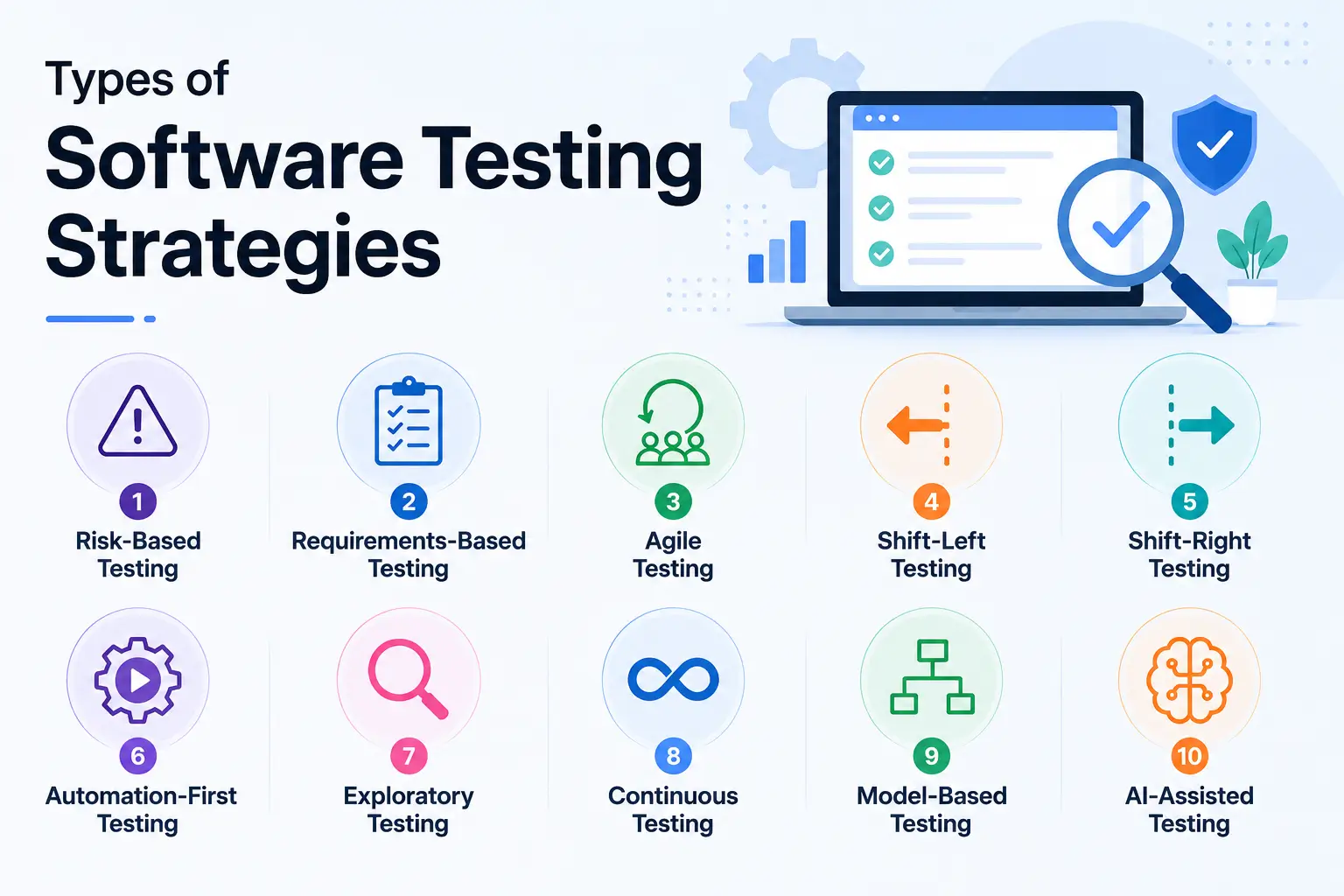
1. Risk-Based Testing
Risk-based testing prioritizes testing efforts according to the likelihood and impact of failure. Features are evaluated based on factors such as business criticality, technical complexity, change frequency, and user impact.
This approach helps teams focus limited testing resources on areas where defects would cause the greatest damage. It is particularly useful when release timelines are tight and comprehensive testing is not practical.
For example, a banking application may devote more testing effort to payment processing and transaction workflows than to less critical account management features.
2. Requirements-Based Testing
Requirements-based testing derives test cases directly from documented business and technical requirements. Each requirement is mapped to one or more test cases to ensure complete coverage.
The primary advantage is traceability. Teams can demonstrate that every requirement has been validated, which is especially important in regulated industries.
This strategy is widely used in banking, telecommunications, healthcare, and government projects where compliance and audit readiness are critical.
3. Agile Testing
Agile testing integrates testing activities throughout the development process rather than treating testing as a separate phase.
Developers, testers, and product owners collaborate continuously, allowing teams to identify issues earlier and adapt quickly to changing requirements.
This strategy works well for organizations that release software frequently and rely on iterative development practices.
4. Shift-Left Testing
Shift-left testing moves testing activities closer to the beginning of the development lifecycle.
Instead of waiting until features are completed, teams validate requirements, designs, code, and integrations as early as possible. This shortens feedback cycles and reduces the cost of fixing defects.
Shift-left testing is commonly used in CI/CD environments where rapid feedback is essential.
5. Shift-Right Testing
Shift-right testing extends quality validation beyond pre-production environments and into production.
Techniques such as monitoring, canary releases, feature flags, synthetic testing, and real-user monitoring help teams understand how applications behave under actual operating conditions.
This approach is particularly valuable for SaaS platforms, media applications, and large-scale distributed systems where production behavior cannot be fully replicated in test environments.
6. Automation-First Testing
Automation-first testing treats automation as the default testing approach whenever practical.
Automated tests provide consistent execution, broad regression coverage, and rapid feedback across development pipelines. Manual testing is reserved for scenarios that require human judgment or exploratory investigation.
This strategy is most effective for products with stable functionality and frequent release cycles.
7. Exploratory Testing
Exploratory testing relies on the tester's experience, domain knowledge, and curiosity rather than predefined test scripts.
Testers actively investigate the application, following unexpected behaviors and exploring edge cases that structured test cases may miss.
It is particularly effective for new features, complex workflows, usability evaluation, and identifying defects that are difficult to predict during test planning.
8. Continuous Testing
Continuous testing integrates automated testing throughout the software delivery pipeline.
Tests are executed continuously as code changes move through development, integration, staging, and release environments. This provides rapid feedback and helps teams identify issues before they reach production.
Organizations practicing DevOps often use continuous testing to support frequent and reliable releases.
9. Model-Based Testing
Model-based testing generates test cases from system models such as state diagrams, flowcharts, and decision tables.
Because tests are derived from models rather than manually written, teams can update the model and regenerate tests when requirements change.
This strategy is especially useful for complex systems with extensive business rules, such as telecommunications platforms, embedded systems, and financial applications.
10. AI-Assisted Testing
AI-assisted testing uses artificial intelligence to support activities such as test generation, test prioritization, anomaly detection, failure analysis, and script maintenance.
AI can reduce manual effort and help teams manage large test suites more efficiently. However, it does not eliminate the need for human oversight, domain expertise, or well-defined testing objectives.
This approach is particularly valuable for teams that spend significant time maintaining automation frameworks and investigating test failures.
How to Develop an Effective Software Testing Strategy
Building a strategy is a repeatable process, not a document you write once and bury in a wiki. Start by aligning it with your development methodology. Agile and extreme programming lean on continuous testing and rapid feedback; the spiral model emphasizes iterative risk analysis; Waterfall and the V-Model want sequential, structured phases. With that alignment set, these steps hold up under real pressure.
1. Define business objectives: Start with the outcomes the business wants to achieve. These may include reducing production incidents, increasing release frequency, meeting compliance requirements, improving application performance, or enhancing customer experience. Clear business objectives help teams prioritize testing efforts and make informed decisions about coverage, automation, and resource allocation.
2. Assess risks and architecture: Identify the areas where failures would have the greatest business or technical impact.
Evaluate factors such as application complexity, critical user workflows, third-party integrations, APIs, infrastructure dependencies, and deployment architecture. Whether the application is a monolith, a microservices-based platform, or a cloud-native system will influence testing priorities and approaches.
The goal is to understand where defects are most likely to occur and where they would be most costly.
3. Identify quality requirements: Translate business goals and risk assessments into measurable quality criteria.
Examples include performance targets, security requirements, availability objectives, accessibility standards, browser compatibility requirements, and supported device and operating system combinations.
Clearly defined quality requirements provide a benchmark for evaluating release readiness.
4. Select testing approaches: Determine what needs to be tested and what can be excluded. Identify the critical user journeys, business processes, platforms, devices, browsers, integrations, APIs, and environments that require validation.
Scope should be guided by the business objectives, risks, and quality requirements identified in the previous steps. High-risk and business-critical areas typically receive deeper coverage, while low-risk functionality may require less intensive testing.
Clearly defined scope helps teams focus their efforts, avoid unnecessary testing, and allocate resources more effectively.
5. Select Testing Approaches: Once the scope is defined, choose the testing approaches that best address the identified risks and quality goals. Most organizations combine multiple approaches, such as risk-based testing, shift-left testing, automation-first testing, continuous testing, and exploratory testing.
6. Define the automation scope: Determine which tests should be automated and which should remain manual. Automation typically delivers the greatest value for regression testing, critical business workflows, and repetitive test scenarios. A clear automation strategy helps maximize coverage while keeping maintenance effort under control.
7. Choose supporting tools and environments: Create environments that closely reflect production conditions. Define the devices, browsers, operating systems, databases, network configurations, and third-party integrations required for testing. Testing in realistic environments improves confidence that results will accurately represent real-world behavior.
8. Define Metrics and Success Criteria: Establish measurable indicators to evaluate testing effectiveness and software quality. Common metrics include defect escape rate, test coverage, pass rates, release frequency, mean time to detect issues, and mean time to resolve defects. Clear success criteria help teams assess release readiness and identify areas for improvement.
9. Integrate testing into CI/CD: Wire automated tests into your pipelines so feedback arrives with every commit. Continuous integration merges code often and triggers automated builds and tests, catching breakage on the spot. Continuous delivery then moves validated changes toward production with far less manual handling.
10. Refine continuously: Treat the strategy as a living asset. Review metrics, retrospectives, and production incidents on a regular cadence, then adjust. The best strategies evolve with the product, the team, and the ecosystem around them.
Also read - API Testing Strategies: A Complete Guide
Best Practices for Software Testing Strategies
An effective testing strategy requires more than selecting the right testing approaches. Teams must consistently apply practices that improve coverage, reduce risk, and support reliable releases.
- Risk-Based Prioritization: Focus testing efforts on the features and workflows where failures would have the greatest business impact. Critical areas such as payments, authentication, and core user journeys typically require deeper coverage than low-risk functionality.
- Strategic Automation: Automate repetitive, stable, and business-critical test scenarios first. Regression testing, API validation, and frequently executed workflows often provide the highest return on automation investments.
- Real-World Testing: Validate applications on the devices, browsers, operating systems, and network conditions used by actual customers. This helps uncover issues that may not appear in controlled test environments.
- Production-Like Environments: Keep test environments as close to production as possible. Similar configurations, dependencies, and data conditions improve the accuracy of testing outcomes.
- Continuous Quality Measurement: Track meaningful metrics such as defect escape rate, test coverage, release frequency, and failure trends. These metrics help teams evaluate the effectiveness of their testing efforts and identify areas for improvement.
- Cross-Functional Collaboration: Involve QA, development, operations, and product teams throughout the software lifecycle. Early collaboration improves feedback loops and reduces costly late-stage defects.
- Shift-Left and Shift-Right Practices: Combine early testing during development with production monitoring and user insights to achieve broader quality coverage across the software lifecycle.
- Responsible AI Adoption: Use AI to assist with test generation, prioritization, failure analysis, and maintenance while keeping testing decisions guided by human expertise and business context.
- Requirements Traceability: Maintain clear links between requirements, risks, and test cases. This improves coverage visibility, supports compliance efforts, and helps identify testing gaps.
- Balanced Release Decisions: Maintain a balance between delivery speed and software quality. Testing strategies should support rapid releases without compromising reliability or user experience.
Software Testing Trends in 2026
Here is the list of latest software testing trends in that you need to know:
- AI-Powered Test Automation: AI is increasingly being used to generate test cases, create automation scripts, identify coverage gaps, and analyze test results. Teams are spending less time writing and maintaining tests and more time validating application quality.
- Agentic AI in Software Testing: AI agents are beginning to perform testing tasks with minimal human intervention. These systems can understand workflows, generate tests, execute them, analyze failures, and recommend corrective actions.
- Testing AI Applications: As AI-powered applications become more common, organizations are focusing on testing model accuracy, response consistency, security, bias, and reliability. Traditional testing methods alone are often insufficient for validating AI systems.
- Continuous Quality Engineering: Quality is becoming a shared responsibility across development, testing, operations, and security teams. Organizations are embedding quality practices throughout the software development lifecycle rather than treating testing as a separate phase.
- Real Device Testing: Teams continue to increase their reliance on real devices to validate application behavior under actual user conditions. This approach helps uncover issues that may not appear in simulated environments.
- Shift-Left and Shift-Right Testing: Organizations are testing earlier in development while also monitoring software after release. This combination helps identify defects sooner and provides insight into real-world user experiences.
- Performance Engineering: Performance validation is moving from periodic testing to continuous analysis. Teams are evaluating application responsiveness, scalability, and resource utilization throughout the development lifecycle.
- API-First Testing: With modern applications relying heavily on APIs and microservices, organizations are prioritizing API testing to identify issues before they affect user-facing interfaces.
- Security Testing in CI/CD Pipelines: Security checks are increasingly integrated into automated development pipelines. This helps teams identify vulnerabilities earlier and reduce the risk of security issues reaching production.
- Observability-Driven Testing: Testing strategies are increasingly informed by production data, including logs, metrics, traces, and user behavior. This helps teams focus testing efforts on areas with the highest risk.
- Visual and User Experience Testing: Organizations are paying greater attention to visual consistency, accessibility, and overall user experience. Automated visual testing is helping teams detect interface issues before release.
- Cloud-Based Testing Platforms: Cloud testing environments continue to gain adoption because they provide scalable access to devices, browsers, operating systems, and network conditions without requiring extensive in-house infrastructure.
- Low-Code and No-Code Test Automation: Testing tools are becoming more accessible to non-developers through visual interfaces and AI-assisted workflows. This allows broader participation in automation efforts across teams.
- Testing for Distributed Systems: As cloud-native architectures become more common, testing strategies are evolving to address the complexity of microservices, containers, and distributed applications.
- Sustainable Testing Practices: Organizations are beginning to optimize testing processes to reduce infrastructure consumption, eliminate redundant test execution, and improve overall efficiency.
How HeadSpin Helps in Implementing Software Testing Strategies
A testing strategy is only effective if teams can execute it consistently across devices, networks, locations, and releases. In practice, testing often drifts from the original plan because environments differ, builds change, and execution becomes fragmented.
- Global Device Infrastructure: HeadSpin provides access to real devices across global locations and supports testing on carrier networks, helping teams execute tests on the environments their users actually rely on.
- App Management Hub and Test Execution Management (TEM): App Management Hub enables centralized build management, while TEM allows teams to run mobile test suites on real devices in the cloud. This helps maintain consistency across test runs and releases.
- Automated Test Execution: HeadSpin supports the execution of automated mobile test suites across multiple devices and environments, helping teams scale regression testing and integrate testing into CI/CD workflows.
- Waterfall UI and Performance Insights: HeadSpin captures device, network, and application performance data during test execution. Through the Waterfall UI, teams can analyze performance metrics, investigate issues, and validate whether quality objectives are being met before release.
Conclusion
An effective software testing strategy is not a one-time exercise. It should evolve alongside the product, the technology stack, and business priorities.
Start by aligning testing efforts with business goals and risk areas. Focus on the functionality that matters most, automate where it adds value, and continuously measure outcomes. As applications become more complex, regularly review and refine the strategy based on quality metrics, production insights, and changing requirements.
The tools and techniques may evolve, but the objective remains the same: deliver reliable software with confidence.
Frequently Asked Questions (FAQs)
Q1. What is a software testing strategy?
Ans: A software testing strategy is a high-level framework that defines how an organization plans, organizes, executes, and governs testing across the development lifecycle. It connects testing effort to business goals and guides the decisions behind every individual test case.
Q2. Why is a testing strategy important?
Ans: A testing strategy reduces risk, improves software quality, accelerates release cycles, and builds confidence in deployment. It ensures testing focuses on what matters most rather than on whatever happens to be easiest to test.
Q3. What is the difference between a test plan and a test strategy?
Ans: A test strategy is the high-level, long-lived approach to quality across the organization. A test plan is a detailed, project-specific document describing how a particular release will be tested. The strategy sets direction; the plan executes it for a specific release.
Q4. What are common testing strategies?
Ans: Common software testing approaches include risk-based testing, requirements-based testing, agile testing, shift-left and shift-right testing, automation-first testing, exploratory testing, continuous testing, model-based testing, and AI-assisted testing. Most teams blend several.
Q5. What is risk-based testing?
Ans: Risk-based testing prioritizes effort based on the likelihood and impact of failure. You identify risk factors, score features against them, and concentrate the most rigorous coverage on high-risk, high-impact areas,valuable when time is limited.
Q6. How does automation fit into a testing strategy?
Ans: A test automation strategy defines what to automate, which frameworks to use, and how to maintain suites over time. Automation handles repetitive, stable, high-value checks,often run in parallel and around the clock,while people focus on exploratory and judgment-heavy testing.







-1280X720-Final-2.jpg)