.png)


.png)


AI-Powered Key Takeaways


Table of Contents

Telcos have always tracked network KPIs, and they should. Availability, latency, jitter, packet loss, throughput, handover success, drop rates: these metrics keep the lights on.
But competition has shifted. Customers do not experience latency in isolation; they experience a WhatsApp call that turns robotic, a banking app that freezes mid OTP verification, a video that starts blurry and buffers during the best part, or a roaming session that works in one city and collapses in another. That gap, between what the network reports and what the user feels, is where brands win or lose.
What this really means is simple: network KPIs tell you how the network behaves, real-world performance tells you how your service is remembered.
Why network KPIs stop short
Network KPIs are necessary, but they are not sufficient because:
- Weekly aggregates of network KPIs might look healthy, but specific KPIs for device models, OS versions, or carrier paths may reveal issues that affect the perceived user experience.
- A “good” throughput number does not guarantee fast checkout, stable video playback, or clean voice - these are performance issues. For example, to measure these, you will need to track device-level performance metrics to understand core issues.
Regulators and standards bodies such as TRAI (Telecom Regulatory Authority of India) have long recognized the difference between technical service quality and user satisfaction. Quality of service (QoS) is the technical view, and Quality of experience (QoE) is the user’s perception; the relationship is not one-to-one.
So if your competitive story is only network KPIs, you are leaving money on the table, and leaving churn risk invisible until it shows up in complaints.
A better hierarchy: Network KPIs → Service KQIs → Experience outcomes
A practical way to think about real-world performance is a three-layer model:
1) Network KPIs (what the network did)
These are your classic measurements:
- Latency, jitter, packet loss, throughput
- Call drop rate, handover success, and attach success
- DNS, TCP/TLS timings, retransmissions (where available)
They matter, and you still need them, because these are the foundational network performance requirements.
2) Service level KQIs (what the service delivered)
This is where telcos start competing, because KQIs translate network behavior into service quality. Examples:
- Voice: MOS, one-way delay, jitter impact,
- Video: startup time, distortion, compression, content, bitrate stability, resolution shifts
- Data services: time to first byte, page load time, API response time
MOS is a good example. It is widely used in telecom to represent perceived voice or video quality, typically on a 1-5 scale, and is standardized by the ITU.
3) Experience outcomes (what customers remember)
This is the commercial layer:
- Churn risk signals tied to poor sessions
- Repeat complaints for the same journey
- App store rating drops after releases
- Customer care volume tied to specific regions, devices, or roaming corridors
This is where real-world performance becomes a strategy, not just monitoring.
Also Read - How Can Testing Mobile Apps in Real-World Network Conditions Improve Performance and User Experience?
The competitive reality: video streaming and app experience dominate user perception
In most mobile networks, video accounts for the majority of traffic and heavily shapes user perception. Ericsson reports that video traffic accounts for a large share of mobile data traffic, and that share is expected to keep rising.
That matters because “network is up” is not the same as “Netflix starts instantly” or “short form video does not stutter on the metro.”
Telcos that can prove, measure, and improve these real-user moments to gain a defensible edge, especially as price and coverage become increasingly similar.
What to measure if you want to compete on real-world performance
Here’s a KPI set that connects engineering effort to customer reality. The goal is not more dashboards, it’s fewer blind spots.
Network layer KPIs
- keep them, but make them actionable
Use case: Customers complain that data feels slow only during evening commutes, or roaming users report inconsistent connectivity even though network uptime looks solid.
Network KPIs become essential when they’re sliced by device model, location, roaming status, and time of day. This helps telcos identify congestion corridors, device-specific radio issues, and roaming partner weaknesses that are invisible in regional or weekly averages.
App and critical user journey KPIs
- where experience actually breaks
Use case: Login works, but payments fail intermittently. Video starts fine, but stalls mid-session. IVR calls connect, but users drop before completion.
App and journey KPIs show whether users can actually complete key actions. Measuring launch time, screen loads, crashes, and end-to-end API latency reveals exactly where journeys slow down or break, even when backend systems look healthy.
Device KPIs
- the silent killers, why?
Use case: The same service performs well on some phones but drains battery, freezes, or stutters on others.
Device KPIs expose CPU spikes, memory pressure, and battery drain that degrade experience despite stable connectivity. This helps telcos separate device-induced issues from network problems and avoid fixing the wrong layer.
Audio video KPIs (because that’s what users complain about)
Use case: Users report robotic voice calls, delayed audio, or frequent video buffering despite good signal strength.
Audio and video KPIs like MOS, startup time, buffering frequency, and bitrate stability directly reflect what users hear and see. These metrics help telcos quantify perception, compare performance across regions and carriers, and prove quality improvements.
Also read - Testing Telco Apps Across SIM Profiles, Device, & OS Versions
How HeadSpin fits this problem (and why it matters for telcos)
HeadSpin is built to fill this gap: validating real-world performance across devices, apps, and networks, not just lab assumptions.
1) Real-world telco validation across devices, networks, and roaming paths
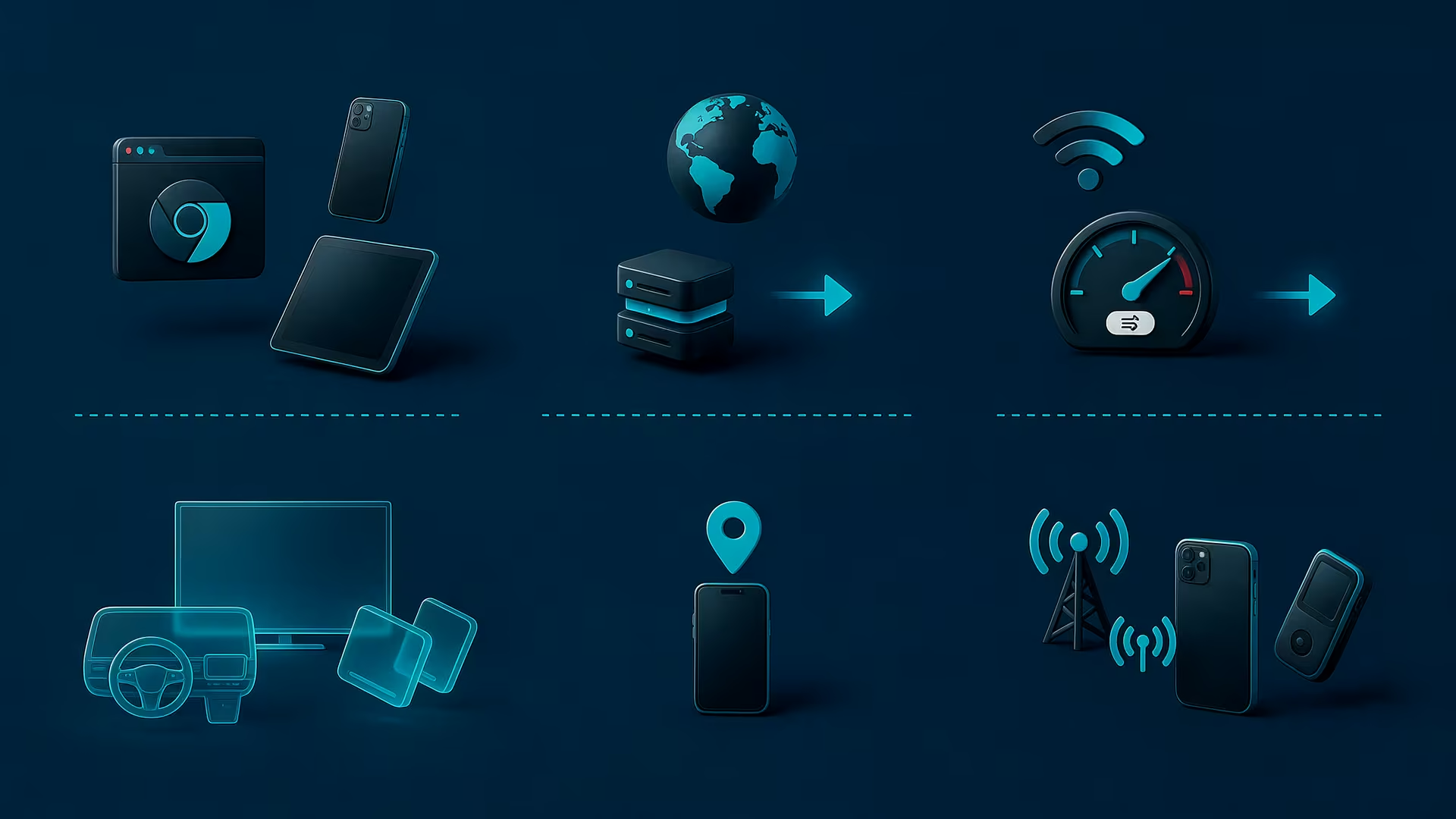
Telco performance issues rarely show up in controlled lab environments. They surface on specific device models, on particular carriers, in certain cities, or only while roaming. This is where real-world validation becomes essential.
HeadSpin’s telco solution enables telcos to test voice, data, SMS, IVR, and roaming scenarios on real devices connected to real carrier networks worldwide. This allows teams to reproduce issues exactly as customers experience them, instead of relying on simulations or assumptions.
The impact is practical and immediate. Telcos can validate 5G services and enterprise offerings before launch, test roaming behavior without moving teams across borders, assess call quality in IVR flows, and benchmark service performance under the same real-world conditions customers face every day. Most importantly, teams can isolate failures to the network, the device, or the service layer, reducing misdiagnosis and accelerating fixes.
2) KPIs across device, app, and network in a single view
HeadSpin captures 130+ performance KPIs across app experience, device vitals, and network behavior, so you can correlate what users feel with what actually happened. That includes examples such as app launch and response times, packet loss and throughput, and device signals such as CPU and memory.
Analyze performance on a second-by-second basis through HeadSpins waterfall UI. Get detailed visualizations of app performance via Grafana dashboards, and leverage issue cards that highlight why and where performance dropped, and provide actionable insights into how to fix them.
4) Continuous monitoring, regression detection, and dashboards
For telcos, the question is not “is it good once,” it’s “did it get worse in this build, this carrier config, this region.” HeadSpin supports performance monitoring with KPI tracking, cross-build comparisons, and dashboarding workflows (including Grafana-oriented monitoring).
KPIs still matter, but only if they reflect reality
Network KPIs are the foundation. But telcos compete on what customers actually experience across apps, devices, and real networks. The winners will be the operators who can measure that reality, prove it, and consistently improve it.
HeadSpin helps telcos do precisely that by combining real device testing, real network validation, and deep KPI visibility across device, app, and network performance, so teams can move from “the network looks fine” to “the experience is actually great.”
FAQs
Q1. How early in the service lifecycle should telcos start tracking experience-level KPIs?
Ans: Experience-level KPIs should be tracked from pre-launch and pilot phases onward. Identifying performance gaps before commercial rollout reduces post-launch incidents, customer complaints, and costly emergency fixes. Early visibility also helps teams set realistic performance baselines for future monitoring.
Q2. What role does automation play in measuring real-world telco performance?
Ans: Automation enables repeatable testing of critical journeys such as call setup, IVR navigation, roaming attach, and video playback. Automated workflows enable continuous performance tracking, cross-release comparison, and early detection of regressions without relying solely on manual testing or customer complaints.


Siddharth Singh
Senior Product Manager, HeadSpin Inc.




-1280X720-Final-2.jpg)