.png)


AI-Powered Key Takeaways


What are Test Automation Frameworks?
A test automation framework is a collection of rules or guidelines for generating and designing test cases. It includes a combination of practices and tools developed to assist the QA professionals in testing more effectively. Moreover, these guidelines may encompass coding standards, object repositories, test-data handling techniques, processes for securing test results, and data on accessing external resources.
These rules are mandatory, and testers must design or record tests without adhering to them. However, accessing an organized framework offers more benefits that professionals would miss out on otherwise. In this blog, we shed light on some of the prominent types of automated testing frameworks.
Automated Testing Frameworks are designed to simplify the process of testing software applications. They provide a structured environment where test scripts can be executed and their outcomes evaluated without manual intervention. This approach reduces the effort involved in repetitive testing tasks, leading to increased efficiency and accuracy in the software development lifecycle.
Read: Navigating the Complexities of Mobile App Testing Throughout the SDLC
15 Popular Test Automation Frameworks in 2026
Selecting the proper test automation framework ensures software quality and accelerates release cycles. Open-source frameworks offer flexibility, community support, and cost-effectiveness. Below are some of the best open-source test automation frameworks widely adopted by professionals:
1. Appium
Pricing: Free — fully open source.
Advantages: Cross-platform mobile support (iOS, Android), multiple language bindings (Java, Python, JS), strong community backing, integrates with CI/CD and real device grids.
Disadvantages: Setup and environment configuration can be complex; tests can run slower than native frameworks; occasional flakiness with unstable selectors.
Best for: Mobile automation where you need one test suite for multiple platforms and languages.
2. Detox
Pricing: Free (open source).
Advantages: Built specifically for React Native; runs tests on simulators and real devices; app-synchronized execution (tests run in app’s event loop).
Disadvantages: Less flexible than Appium for non-React Native apps; smaller ecosystem; focused on mobile end-to-end.
Best for: End-to-end testing of React Native mobile apps.
3. Selenium
Pricing: Free (open source).
Advantages: Industry standard for browser automation; supports many languages and browsers; flexible with CI/CD tools.
Disadvantages: Requires manual setup of drivers and test infrastructure; mobile testing support is limited compared with dedicated tools; maintenance overhead on large suites.
Best for: Web UI automation with multi-browser coverage.
4. WebDriverIO
Pricing: Free (open source).
Advantages: Node.js-based, integrates with Selenium and native protocols; rich plugin system; built-in test runner and REPL.
Disadvantages: JavaScript ecosystem only; additional plugins may be needed for full reporting.
Best for: Web and hybrid test automation in JavaScript projects.
5. Playwright
Pricing: Free (open source).
Advantages: Reliable cross-browser support; auto-waiting, network and context control; supports JS, Python, C#, and Java.
Disadvantages: Newer (smaller ecosystem than Selenium); steep featureset can be overwhelming at first.
Best for: Modern web automation including parallel cross-browser tests.
6. TestCafe
Pricing: Free (open source).
Advantages: Zero browser plugins needed; works out of the box; parallel tests and built-in waits.
Disadvantages: Less customizable than Selenium; largely JS/TypeScript only.
Best for: Fast setup and execution in web environments, especially JavaScript stacks.
7. Robot Framework
Pricing: Free (open source).
Advantages: Keyword-driven syntax makes tests readable; integrates with Selenium, Appium, API libraries; low code required.
Disadvantages: Large suites can become hard to maintain; keyword design takes up-front planning.
Best for: Teams that want reusable, readable tests with minimal code.
8. JUnit
Pricing: Free (open source).
Advantages: Standard for Java unit and integration tests; integrates tightly with build tools like Maven/Gradle.
Disadvantages: Focused on unit testing; UI and end-to-end require frameworks on top.
Best for: Java code unit and simple integration tests.
9. NUnit
Pricing: Free (open source).
Advantages: Strong .NET ecosystem support; rich assertions and test runners; parallel execution.
Disadvantages: Not suited alone for UI automation; needs additional tooling for end-to-end.
Best for: .NET unit and functional testing.
10. Mocha
Pricing: Free (open source).
Advantages: Flexible JavaScript test framework; supports async testing; good with other assertion libraries.
Disadvantages: Minimal built-in features; needs plugins for full test suite reporting and coverage.
Best for: Unit and API testing in JavaScript applications.
11. Jasmine
Pricing: Free (open source).
Advantages: BDD-style syntax; minimal dependencies; runs in browsers and Node.js.
Disadvantages: Limited to JavaScript; basic reporting unless extended.
Best for: JavaScript BDD tests.
12. PyTest
Pricing: Free (open source).
Advantages: Simple syntax; fixtures and plugins; great for Python unit, API, and functional tests.
Disadvantages: Not targeted at UI without extensions; setup varies by project.
Best for: Python-based testing across unit and functional scopes.
13. RSpec
Pricing: Free (open source).
Advantages: Readable BDD syntax for Ruby; excellent for behavior specification.
Disadvantages: Ruby only; requires learning BDD style.
Best for: BDD with Ruby applications.
14. JBehave
Pricing: Free (open source).
Advantages: BDD for Java; plain-text scenarios link to automation.
Disadvantages: Extra abstraction can make complex scenarios cumbersome.
Best for: Java teams adopting BDD workflows.
15. PHPUnit
Pricing: Free (open-source).
Advantages: Tight integration with PHP ecosystems and CI/CD pipelines. Fast execution for unit-level feedback.
Disadvantages:Primarily focused on unit testing, not full UI or end-to-end automation.
Best for: PHP teams that want reliable unit testing as the foundation of their automation strategy, especially in backend-heavy or API-driven applications.
Benefits of Test Automation Frameworks
Automation testing frameworks offer many advantages, transforming the landscape of software testing. These benefits are pivotal in enhancing the efficiency of testing processes. Let's delve deeper into these benefits:
- Increased Efficiency and Speed: Automation frameworks significantly expedite the testing process. By automating repetitive and time-consuming tasks, these frameworks allow tests to run faster and more frequently, which is especially beneficial for regression testing, where the same tests must be repeated for different software versions.
- Enhanced Accuracy and Consistency: Human testers are prone to errors, especially when performing monotonous and repetitive tests. Automation eliminates this variability, ensuring that tests are performed consistently every time. This consistency is vital in detecting issues you can miss during manual testing.
- Cost-Effectiveness in the Long Run: While the initial setup of automated testing frameworks may require investment, they are cost-effective over time. The ability to run tests repeatedly without additional costs leads to long-term savings, as it reduces the need for manual testing resources.
- Scalability and Flexibility: Automation frameworks are highly scalable, allowing teams to easily add new test cases and adapt to software features or design changes. This scalability is crucial for accommodating the growth and evolution of software applications.
- Improved Test Coverage: Automated testing can easily cover many test scenarios, including complex and tedious ones that might be challenging to execute manually. This comprehensive coverage ensures a thorough evaluation of the software's functionality and performance.
Adopting automation testing frameworks brings about transformative benefits, from enhancing efficiency and accuracy to ensuring high-quality software development. These frameworks are integral to modern software development strategies, enabling teams to meet their objectives more effectively and efficiently.
Read: Top 20 Automated API testing Tools for Effective Software Testing
Types of Test Automation Frameworks
1. Linear Scripting Framework
In a linear test automation framework, testers are not required to write code or generate functions. Moreover, the steps in it are written chronologically, and the process is also known as the record-and-playback framework. The tester records every step, like checkpoints, user input, navigation, etc., and then it is automatically played back to conduct the test. Considering there is no need for custom code, this framework can be executed without any expertise in test automation.
Advantages
- Simplicity and Clarity: Linear scripting is straightforward, making it easier to understand and follow. It's particularly beneficial for beginners or when a clear, unambiguous progression is needed.
- Predictability: Since the script follows a defined path, outcomes are predictable, which aids in planning and resource allocation. This predictability is essential in many programming and narrative contexts.
- Ease of Debugging: A straightforward flow makes identifying and fixing issues simpler. There are fewer variables and branching paths to consider for effectively streamlining the debugging process.
Disadvantages
- Lack of Flexibility: Linear scripting is often criticized for its rigidity. It doesn't easily accommodate changes or adapt to user inputs or scenarios.
- Limited User Engagement: In games and interactive media, linear scripting can lead to a less engaging experience, as it offers limited options and interactivity for the user.
- Predictability Can Be a Downside: While predictability is an advantage in some cases, it can also be a drawback. In narrative and game design, predictability can lead to boredom or a lack of challenge.
2. Modular Testing Framework
A modular testing framework requires testers to divide the application into separate testing categories like functions, units, sections, etc. Each of the classes is tested individually. Once the application is divided, testers create a test script for every part; they are then combined to create more extensive tests hierarchically. Additionally, the larger test sets work to represent different test applications. In the modular form of a testing framework, it is recommended to build an abstraction layer. This way, the sections won't influence the overarching module.
Advantages
- Reusability: By dividing tests into independent, reusable modules, the framework facilitates reusability, which can significantly save time and resources.
- Maintainability: Updates or fixes can be applied to individual modules without affecting the entire suite, enhancing maintainability.
- Scalability: The framework can easily accommodate or expand new tests, making it highly scalable.
Disadvantages
- Initial Setup Time: Setting up a modular testing framework can be time-consuming and requires careful planning.
- Complexity in Integration: Integrating different modules can sometimes lead to complexities, especially if the modules are not designed with integration in mind.
- Dependency Management: Managing dependencies between modules can be challenging and may require additional tools or strategies.
3. Library Architecture Testing Framework
The library architecture testing framework identifies similar tasks within the scripts and splits them into groups based on the function, rather than dividing the app under various tests. This allows the application to be grouped by the common objectives. Moreover, functions are stored in the library that they can access whenever needed.
Advantages:
- Consistency and Standardization: Ensures all library components adhere to a defined architectural standard, leading to more consistent and predictable behavior.
- Early Detection of Issues: Helps identify architectural issues early in the development process, reducing the time and cost of fixing them later.
- Improved Code Quality: Encourages better coding practices and architectural decisions, leading to higher overall code quality.
Disadvantages:
- Initial Setup Complexity: Setting up an architecture testing framework can be complex and time-consuming.
- Possible Overhead: May introduce additional overhead in the development process, especially if it's too rigid or not well-integrated.
- Learning Curve: There's a learning curve for developers to understand and effectively use the framework, making the process complex.
Check out: Native, Web, Hybrid, & Progressive Web Apps: Development and Testing
4. Data-Driven Framework
The data-driven framework breaks up script logic and test data and allows the testers to store data in the framework externally. At times, testers need to test a particular feature or function at different times with multiple data sets. In such situations, testers cannot rely just on the data coded into the script. This framework allows the testers to store and pass various parameters to test scripts from different data sources like text files, excel spreadsheets, ODBC repositories, SQL tables, etc.
Advantages:
- Improved Decision-Making: Data-driven frameworks improve decision-making based on empirical evidence and analytics, which can lead to more accurate and objective outcomes.
- Increased Efficiency: Automating data analysis help streamline processes, reducing time spent on manual data handling.
- Enhanced Customer Insights: Data-driven approaches provide deep insights into customer behavior, aiding in better-targeted products and services.
Disadvantages:
- Data Quality and Integrity Issues: A data-driven framework's effectiveness depends on how accurate and good the data is because poor data quality will bring misleading insights.
- Privacy and Security Concerns: Handling large amounts of data, especially personal data, raises significant privacy and security concerns.
- Complexity and Resource Intensity: Implementing a data-driven framework is complex and resource-intensive, requiring specialized skills and technology.
5. Hybrid Testing Framework
A hybrid test automation framework amalgamates different forms of testing automation frameworks to help leverage the potential of each while eliminating their weaknesses. Each application is different, and the process of testing these applications needs to be distinctive as well. And leveraging a hybrid framework allows testers to be more adaptable and agile to get better test results.
Advantages
- Flexibility and Scalability: Hybrid frameworks are highly adaptable to changing requirements and can easily scale as the complexity of the software grows.
- Reusability: They allow for the reuse of test scripts, reducing the effort required for test development.
- Increased Test Coverage: Integrating different approaches ensures more comprehensive test coverage.
Disadvantages
- Complexity: Integrating multiple frameworks can lead to increased complexity, making it more challenging to understand and manage.
- Higher Initial Setup Cost and Time: Setting up a hybrid framework requires more time and resources than simpler frameworks.
- Skilled Resources Required: Testers demand a higher level of expertise to use and maintain the framework efficiently.
Also read: Data-Driven Reasons to Use Audio Visual AI for End-to-End Testing
How to Choose the Right Test Automation Framework?
Selecting the most suitable test automation framework is a pivotal decision in software development. This choice should be based on a thorough analysis of various factors, each of which plays a key role in understanding the strength of the testing process.
- Project Requirements: For project requirements, organizations can take into account the size, complexity, and type of application they are testing. For instance, a data-driven framework might be ideal for applications where input data varies significantly.
- Team Expertise: It’s vital that organizations assess the skill level of their testing team. Complex frameworks require a steep learning curve and more advanced programming skills. Opt for a framework that aligns with your team's abilities to ensure effective utilization.
- Maintainability and Scalability: Organizations can look for frameworks that are easy to maintain and scale as their application grows. Modular and hybrid frameworks are often preferred for large-scale projects due to their scalability and ease of maintenance.
- Integration Capabilities: Integration capabilities involve considering how well the framework integrates with other tools and technologies used in your project. This includes version control systems, continuous integration tools, and reporting tools.
- Flexibility and Customization: The ability to customize the framework to meet specific project needs can be a significant advantage. This includes custom reporting, integration with other tools, or adding specific functionalities.
The decision to choose a test automation framework should be made after careful consideration of these factors. It's about finding the right balance between the project's needs, team capabilities, and the overall goals of the software development process. This strategic approach ensures that the selected framework meets current requirements and is adaptable to future changes and advancements in the field.
Challenges in Implementing Automation Testing Frameworks
While automation testing frameworks offer many benefits, their implementation is not without challenges. Organizations must consider these potential pitfalls carefully when integrating these frameworks into their testing processes.
- Selection of the Appropriate Framework: One of the primary challenges lies in choosing the right framework. The selection depends on various factors, such as the nature of the project, the testing team's skill set, and the software application's specific requirements. A mismatch in this selection can lead to inefficiencies in the testing process, increased costs, and delayed project timelines.
- Initial Setup: Setting up an automation testing framework often requires a significant initial investment in time and resources. There's also a learning curve involved, especially for teams transitioning from manual to automated testing. Ensuring team members are adequately trained and equipped to handle the new system is crucial for its successful implementation.
- Maintenance of Test Scripts: Over time, as the software evolves, maintaining the test scripts can become a challenging task. You need to regularly review and update test cases to align with the changes in the application. This ongoing maintenance requires dedicated effort and can be resource-intensive.
- Integration with Other Tools and Systems: Automation testing frameworks must integrate various tools and systems, such as CI/CD pipelines, version control systems, and more. Ensuring seamless integration and compatibility can be a technical challenge.
While adopting an automation testing framework can enhance the testing process, organizations must navigate these challenges with strategic planning and continuous evaluation. This ensures that the benefits of automation are fully realized while minimizing potential drawbacks.
Advantages and Disadvantages of Test Automation Frameworks
Advantages
- Speed: Automated tests run faster than manual execution, especially for regression testing.
- Consistency: Tests are repeatable and not prone to human error.
- Coverage: Large and complex applications can be validated across multiple browsers, devices, and operating systems.
- Integration: Most frameworks integrate with CI/CD pipelines, enabling continuous testing.
- Reusability: Test scripts can be reused across projects and builds.
- Reporting: Many frameworks generate detailed reports that help in debugging and tracking quality trends.
Disadvantages
- Initial setup cost: Implementing and configuring a framework requires time and skilled resources.
- Maintenance effort: Test scripts need frequent updates when applications change.
- Flakiness: UI-driven tests may fail due to timing issues, environment instability, or network delays.
- Skill requirements: Teams often need programming knowledge to write and maintain tests effectively.
- Overhead for small projects: For small applications, the investment in automation may not always justify the return.
How HeadSpin Helps Adopt Test Automation
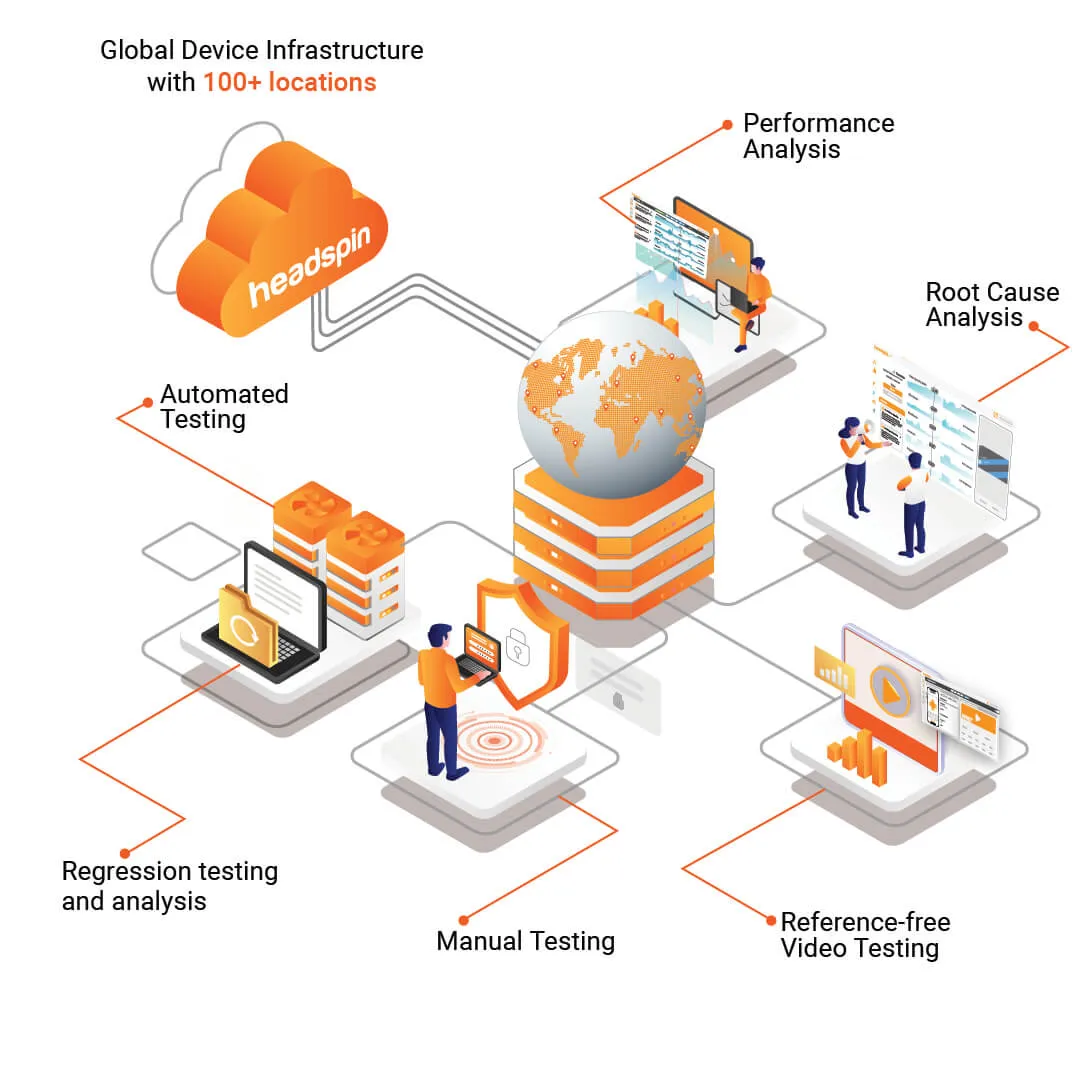
HeadSpin, a leader in mobile application testing, offers solutions that embody the principles of effective automated testing. Their platform supports various testing frameworks, ensuring high-quality application performance across devices.
HeadSpin helps organizations integrate with test automation frameworks like Appium, Appium inspector, Selenium, Xcode,Cucumber, Flutter, and more. With various APIs, issue tracking systems, CI/CD workflow integration capabilities, HeadSpin is fully equipped to help you with your test automation requirements.
Conclusion
Understanding and effectively utilizing automated testing frameworks is crucial in today's fast-paced software development environment. Organizations can deliver high-quality software products by choosing the right framework and leveraging platforms like HeadSpin.
FAQs
Q1. Do I need to use only one framework?
Ans: No. Many teams adopt a combination. For example, Selenium for browser tests, PyTest for APIs, and JUnit for unit tests in Java.
Q2. Are Behavior-Driven Development (BDD) frameworks necessary?
Ans: Not mandatory. Frameworks like JBehave, Jasmine, or RSpec are useful when collaboration between technical and non-technical stakeholders is needed, but they add extra overhead if that’s not a requirement.
Q3. Do these frameworks integrate with CI/CD systems?
Ans: Yes. Most open-source frameworks integrate with tools like Jenkins, GitHub Actions, GitLab CI, and Azure DevOps.


Table of Contents





-1280X720-Final-2.jpg)